<div class="csl-bib-body">
<div class="csl-entry">Nanz, T., Bösenhofer, M., Feilmayr, C., Stocker, H., Rieger, J., Gruber, C., & Harasek, M. (2024, July 26). <i>A novel high-heating rate, elevated pressure reactor for the thermochemical conversion of pulverized solids</i> [Poster Presentation]. 40th International Symposium on Combustion - Emphasizing Energy Transition, Milano, Italy. https://doi.org/10.34726/7500</div>
</div>
-
dc.identifier.uri
http://hdl.handle.net/20.500.12708/205363
-
dc.identifier.uri
https://doi.org/10.34726/7500
-
dc.description.abstract
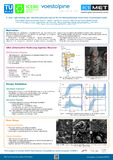
The thermochemical conversion of pulverized solids under non-conventional conditions, e.g., high heating rates, elevated pressures, and short residence times, offers unexplored terrain for research. These conditions are particularly interesting for injecting alternative reducing agents in the raceway zone of blast furnaces. Experimental setups operating at such conditions are rare in the literature. In particular, the heating rates can affect the reactivity of coal and biomass char. The implemented reactor can shed further light on the heating rate and pressure dependence of the thermochemical conversion of solids. However, a rigorous design evaluation must be done beforehand to understand the experimental results fully.
A Computational Fluid Dynamics (CFD) simulation is performed to validate the reactor design regarding temperature, species, and flow profiles. Furthermore, representative particle tracks are created by using Lagrangian injections. The particle tracks are then used to evaluate the particle behavior inside the reactor. The overall simulation is validated using experimental results from previous test runs to ensure the reliability of the simulation results.
The simulation results are in line with the experimental results, and the investigated features are also according to the design criteria. The flow profile inside the reactive zone needs some adaption because the carrier gas jet penetrates the reaction zone too far and delays the conversion process.
The CFD simulations of the novel reactor confirm the design expectations; however, some flow field optimization is required to obtain ideal conditions inside the reactive zone. Furthermore, this novel setup can achieve high heating rates even under higher pressures.
en
dc.description.sponsorship
FFG - Österr. Forschungsförderungs- gesellschaft mbH
-
dc.language.iso
en
-
dc.rights.uri
http://creativecommons.org/licenses/by/4.0/
-
dc.subject
OpenFOAM
en
dc.subject
heterogeneous reaction
en
dc.subject
pulverized coal combustion
en
dc.subject
Computational Fluid Dynamics
en
dc.subject
experimental combustion
en
dc.title
A novel high-heating rate, elevated pressure reactor for the thermochemical conversion of pulverized solids
en
dc.type
Presentation
en
dc.type
Vortrag
de
dc.rights.license
Creative Commons Namensnennung 4.0 International
de
dc.rights.license
Creative Commons Attribution 4.0 International
en
dc.identifier.doi
10.34726/7500
-
dc.contributor.affiliation
TU Wien, Austria
-
dc.contributor.affiliation
Voestalpine (Austria), Austria
-
dc.contributor.affiliation
Voestalpine (Austria), Austria
-
dc.contributor.affiliation
K1 MET GmbH, Austria
-
dc.contributor.affiliation
K1 MET GmbH, Austria
-
dc.relation.grantno
FO999892415
-
dc.type.category
Poster Presentation
-
tuw.project.title
K1MET Kompetenzzentrum für nachhaltige, digitalisierte Metallurgie - klimaneutral und ressourceneffizient "SusMet4Planet"