<div class="csl-bib-body">
<div class="csl-entry">Kiss, M., Bösenhofer, M., Gruber, M., Feilmayr, C., Stocker, H., Gruber, C., & Harasek, M. (2024, July 26). <i>Particleresolved simulation of char combustion in OpenFOAM</i> [Poster Presentation]. 40th International Symposium on Combuston - Emphasizing Energy Transition, Milano, Italy. https://doi.org/10.34726/7503</div>
</div>
-
dc.identifier.uri
http://hdl.handle.net/20.500.12708/205370
-
dc.identifier.uri
https://doi.org/10.34726/7503
-
dc.description.abstract
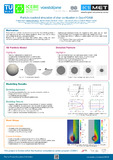
The thermochemical conversion of pulverized solids is essential during combustion in dust-firing systems or injecting pulverized reducing agents in the blast furnace process. When injecting the particles, harsh conditions, e.g., high heating rates, high temperatures, and elevated pressures, can cause substantial intra-particle temperature gradients. Such processes are typically modeled using Euler-Lagrange frameworks assuming isothermal particles. However, resolved particle models are essential to fully understanding the conversion process under these harsh conditions.
A 1D and a novel 3D resolved particle model implemented to OpenFOAM are employed to investigate thermochemical conversion processes under high heating rate conditions. Temperature and species concentration gradients are employed to identify potential conversion bottlenecks and the conversion mode.
Intra-particle temperature gradients of O(10<sup>6</sup>) K/m exist within O(10) µm sized particles under high heating rate conditions. The shrinking particle conversion mode prevails under these conditions. However, a shrinking core mode is superimposed on the shrinking particle one due to the build-up of an ash layer.
Detailed investigations of the thermochemical conversion of pulverized particles is essential to identify potential bottlenecks and improve processes to ensure efficient, total particle burnout. Furthermore, more accurate simplified models can be derived from the detailed particle models, which can be applied in large-scale simulations of industrial processes.
en
dc.description.sponsorship
FFG - Österr. Forschungsförderungs- gesellschaft mbH
-
dc.language.iso
en
-
dc.rights.uri
http://creativecommons.org/licenses/by/4.0/
-
dc.subject
OpenFOAM
en
dc.subject
heterogeneous combustion
en
dc.subject
particle model
en
dc.subject
intra-particle states
en
dc.subject
Computational Fluid Dynamics
en
dc.title
Particleresolved simulation of char combustion in OpenFOAM
en
dc.type
Presentation
en
dc.type
Vortrag
de
dc.rights.license
Creative Commons Namensnennung 4.0 International
de
dc.rights.license
Creative Commons Attribution 4.0 International
en
dc.identifier.doi
10.34726/7503
-
dc.contributor.affiliation
TU Wien, Austria
-
dc.contributor.affiliation
RHI Magnesita (Austria), Austria
-
dc.contributor.affiliation
Voestalpine (Austria), Austria
-
dc.contributor.affiliation
Voestalpine (Austria), Austria
-
dc.contributor.affiliation
K1-MET GmbH, Austria
-
dc.relation.grantno
FO999892415
-
dc.type.category
Poster Presentation
-
tuw.project.title
K1MET Kompetenzzentrum für nachhaltige, digitalisierte Metallurgie - klimaneutral und ressourceneffizient "SusMet4Planet"
-
tuw.researchTopic.id
C2
-
tuw.researchTopic.id
E5
-
tuw.researchTopic.id
E3
-
tuw.researchTopic.name
Computational Fluid Dynamics
-
tuw.researchTopic.name
Efficient Utilisation of Material Resources
-
tuw.researchTopic.name
Climate Neutral, Renewable and Conventional Energy Supply Systems