<div class="csl-bib-body">
<div class="csl-entry">Ell, M. F., Prado-Lopez, S., & Zeck, G. M. (2024, December 2). <i>Digital Tools for Automated Cancer Cell Identification and Cell Cluster Tracking using Adhesion Noise Spectroscopy</i> [Poster Presentation]. Austrian Platform for Personalized Medicine, Vienna, Austria. https://doi.org/10.34726/7504</div>
</div>
-
dc.identifier.uri
http://hdl.handle.net/20.500.12708/205371
-
dc.identifier.uri
https://doi.org/10.34726/7504
-
dc.description.abstract
Background/Aims. CMOS-based microelectrode arrays (CMOS MEAs) are used in biotechnological applications to record neural activity with high spatial (~15 µm) and high temporal resolution (~20 kHz bandwidth) using thousands of densely packed sensor sites [1]. A new application of CMOS MEAs is the label-free and noninvasive detection of adherent cells by studying the voltage noise from the resistive adhesion cleft [2-3]. The voltage noise is described as cell adhesion noise (CAN) and analyzed in terms of spectral power density (SV) [4-5].
Here, we aimed to assess cell proliferation, morphology, and motility of colorectal cancer (CRC) cells in a 2D culture. Therefore, we designed a machine-learning (ML) tool to distinguish between non-cancerous fibroblasts and CRC cells. Next, we correlated the adhesive properties of cancer cells on the CMOS MEA and their morphological and motility features by tracking cells over a certain period of cultivation time.
Methods. The fibroblasts and CRC cells were seeded in monocultures on a CMOS MEA coated with collagen type I and monitored by analyzing CAN in terms of SV at 300 kHz. We related the CAN-based cell identification to light microscopic images. The ML tool was designed with the Python library TensorFlow and cross-validated by randomizing the train and test dataset for multiple runs to ensure the model’s stability [6].
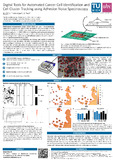
Results. After identifying adherent cells, we trained the ML tool to decide on the cell type by analyzing the CAN-based electrical image. The ML tool performed cell type distinction with a validation accuracy of 84 %. Next, we tracked the CRC cell clusters over three days of culture and selected (i) one cluster with constant size and (ii) one expanding cluster. The CAN for both clusters increased after 48 h to 0.026 µV²/Hz and dropped to 0.018 µV²/Hz after 72 h of cultivation.
Conclusion. Adhesion noise spectroscopy constitutes a potent tool for label-free and noninvasive cancer cell detection with high accordance between electrical and brightfield microscopy imaging. Machine-learning tools benefit from the CMOS MEA’s high spatial resolution, which allows for cell type identification with high accuracy. Tracking cells and clusters over many days in culture allowed us to extract the covered area, the cell adhesion noise, or cell motility over time. Future work aims to record neural activity at a resolution of 6 µm and to detect cancer spheroids and organoids.
1. R. Thewes et al. Neural tissue and brain interfacing CMOS devices — An introduction to state-of-the-art, current and future challenges. IEEE International Symposium on Circuits and Systems (ISCAS), 1826-1829 (2016).
2. M. Voelker, P. Fromherz. Nyquist noise of cell adhesion detected in a neuron-silicon transistor. Physical Review Letters 96(22), 228102 (2006).
3. M. Ell, R. Zeitler, R. Thewes, G. Zeck. Label-free Identification of Nonelectrogenic Cancer Cells using Adhesion Noise. IEEE BioSensors Conference (BioSensors), 1-4 (2023).
4. R. Zeitler, P. Fromherz, G. Zeck. Extracellular voltage noise probes the interface between Retina and Silicon Chip. Applied Physics Letters 99(26), 263702 (2011).
5. M. Ell, M.T. Bui, S. Kigili, G. Zeck, S. Prado-López. Assessment of chemotherapeutic effects on cancer cells using adhesion noise spectroscopy. Frontiers in Bioengineering and Biotechnology 12, 1385730 (2024).
6. F. Chollet. Deep Learning with Python. Manning Publications Co. LLC (2017).
en
dc.language.iso
en
-
dc.rights.uri
http://rightsstatements.org/vocab/InC/1.0/
-
dc.subject
CMOS microelectrode array
en
dc.subject
adhesion noise spectroscopy
en
dc.subject
machine learning
en
dc.subject
cell segmentation
en
dc.subject
electrical imaging
en
dc.subject
cell cluster tracking
en
dc.title
Digital Tools for Automated Cancer Cell Identification and Cell Cluster Tracking using Adhesion Noise Spectroscopy